EEG motor classification
for BCI application
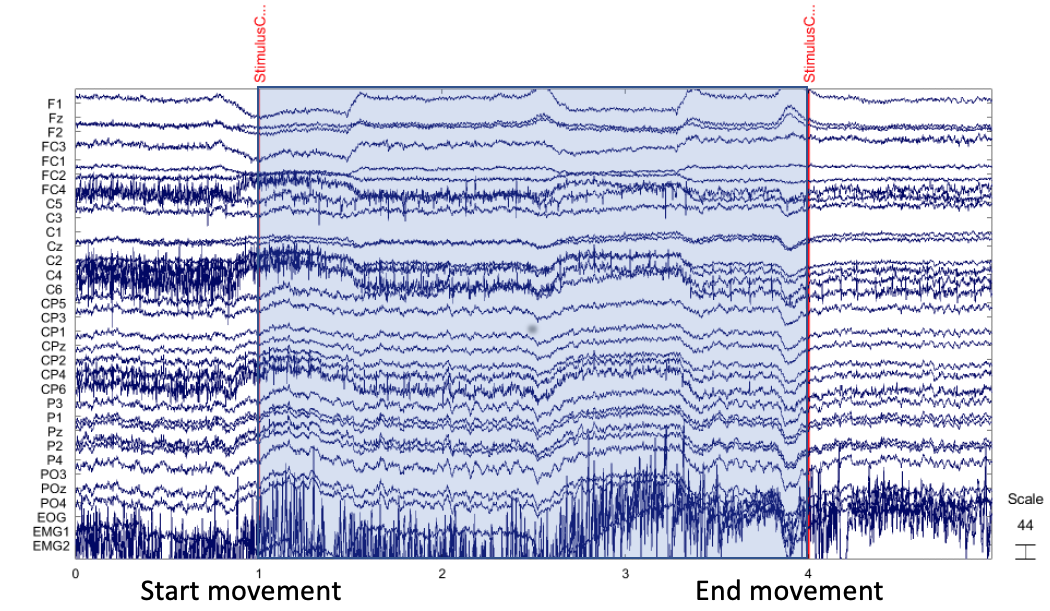
Design of experimental setup, EEG data acquisition, signal processing based on blind source separation and wavelet trasform spectrum extraction.
Extraction of sensorimotor rhytmhs and analysis of Event related Synchronization
Experimental protocol and signal-processing pipeline to classify movement termination based on EEG and EMG data for BCI application. In this paper it is described a blind source separation method integrated with wavelet discrete trasform to extract beta band hypersynchronization related to movement termination in healthy patient. EEG-feedback reinforcement learning based therapy rarely address improvement in grip termination. This preliminary study tries to justify the use of this approach in future experiments on stroke patients where BCI therapy has shown to improve latency of grip initiation and torque exerted. Electroencephalogram (EEG)-based brain-computer interface (BCI) allows individuals to elicit cortical activity and control external devices by merely thinking about the desired movement, this is achieved by recording electric signal over the sensorimotor areas and detecting EEG power changes known as Event-Related Desynchronization and Synchronization (ERD/ERS) in movement-related mu (8–12 Hz) and beta (18–26 Hz) rhythms. Through SMRs, researchers have found a way to decode motor intention, and to train individuals to increase or decrease SMR activity through motor imagery or mental intention (Buch et al., 2008; Ramos-Murguialday et al., 2013;Yuan & He, 2014; McFarland et al. 2015). In particular, this type of rhythm shows recurrent patterns in movement initiation and termination which can be measured as an abrupt change in the power spectra of the signal a few milliseconds before the actual movement called event related desynchronization (ERD). ICA is a statistical strategy for maximizing the independence of observable data by finding linear projections. When used in Blind Source Separation (BSS), ICA seeks to recover distinct sources from mixes of those sources utilizing multi-channel data. EEG, electrocardiogram (ECG), magnetoencephalogram (MEG), and functional magnetic resonance imaging (fMRI) signals have all been successfully processed using ICA over the last two decades. ICA has demonstrated a good ability to separate scalp EEG signals into functionally distinct sources, such as neuronal components emanating from different brain areas and artifactual components related to eye movements, blinks, muscle, heart, and line noise in EEG signal processing. ICA has been effectively utilized to various applications because to its supremacy in EEG source separation such as signal-to-noise ratio (SNR) enhancement of task-related EEG signals, and EEG source localization. Numerous studies using EEG-based BCI have used ICA to increase task-related EEG signals and optimize electrode locations.
Even if literature is full of classification method to properly clean and analyze eeg data windows for movement imagery, using different methods that at the end aim to measure the spectral power over the controlateral sensorimotor cortex in the mu and beta bends, the mechanism underlying movement termination and the spectral correlates in the eeg-signal has not been fully analyzed and understood. In this paper we try to inspect how post stimulus beta (18–26 Hz) rebound (PSBR) can be used as a discrimination feature to classify movement termination respect to the classical integration of the full mu and beta rhythm (8–26 Hz). Currently, machine learning techniques play a key role for what is defined as BCI calibration, a learning phase where the subject specific spatial location and frequency bands are extracted based on classification accuracy metrics and then transferred into the BCI control phase, this is achieved by time consuming sessions where labelled data are collected actively asking to the patient to imagine or perform an actual movement and than the corresponding data are further analyzed. ICA is a statistical strategy for maximizing the independence of observable data by finding linear projections. When used in Blind Source Separation (BSS), ICA seeks to recover distinct sources from mixes of those sources utilizing multi-channel data. EEG, electrocardiogram (ECG), magnetoencephalogram (MEG), and functional magnetic resonance imaging (fMRI) signals have all been successfully processed using ICA over the last two decades. ICA has demonstrated a good ability to separate scalp EEG signals into functionally distinct sources, such as neuronal components emanating from different brain areas and artifactual components related to eye movements, blinks, muscle, heart, and line noise in EEG signal processing. ICA has been effectively utilized to various applications because to its supremacy in EEG source separation such as signal-to-noise ratio (SNR) enhancement of task-related EEG signals, and EEG source localization. Numerous studies using EEG-based BCI have used ICA to increase task-related EEG signals and optimize electrode locations.
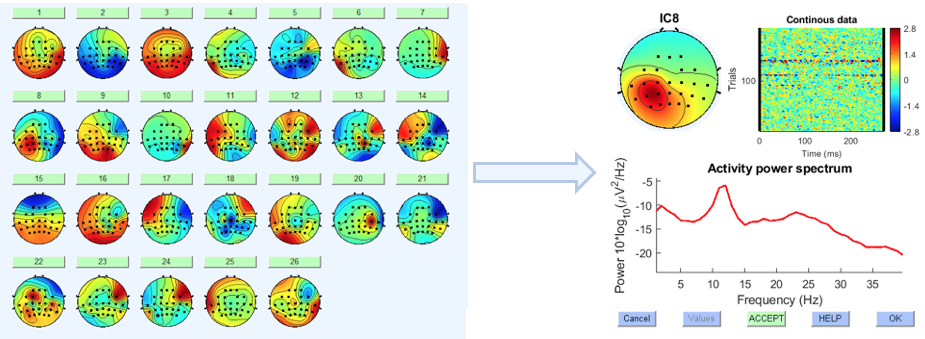
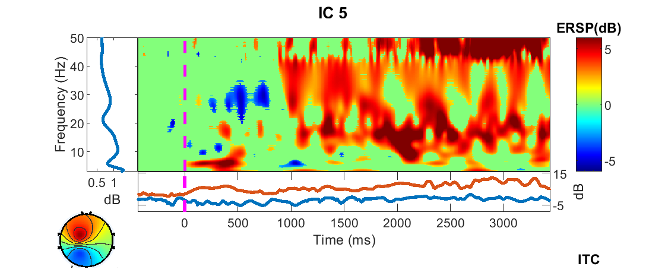
The following criteria were used to identify motor-related components following ICA: (1) the spatial pattern, indicating the component's source location, should match the scalp projection of the sensorimotor cortex on each hemisphere; and (2) the component's power spectrum density (PSD) should match the typical spectral profile of mu/beta rhythms. In practice, a motor component should satisfy both of these requirements. Earlier research established that the number of motor components differed between people.
Event related desynchronization describe the difference in the power spectrum related to a specific task respect to baseline level, they are calculate as follow when using a divisive baseline: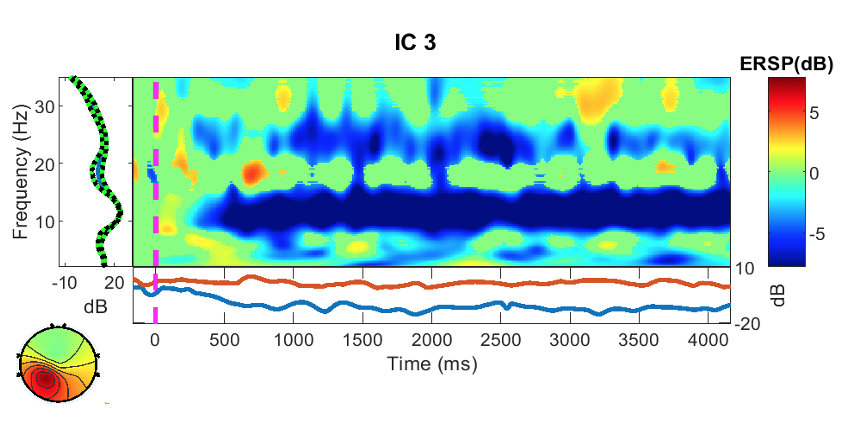

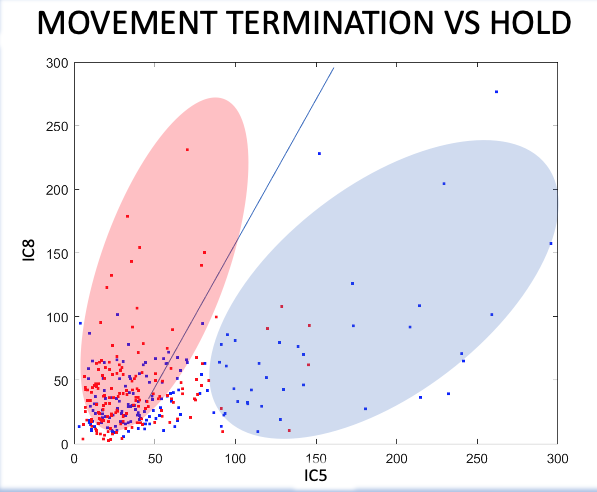
To perform classification we trained a SVM model based on the power spectrum features extracted during the post-processing phase, dividing the signal in 500ms windows to replicate an online application, the overall accuracy of the task was > 80%: